

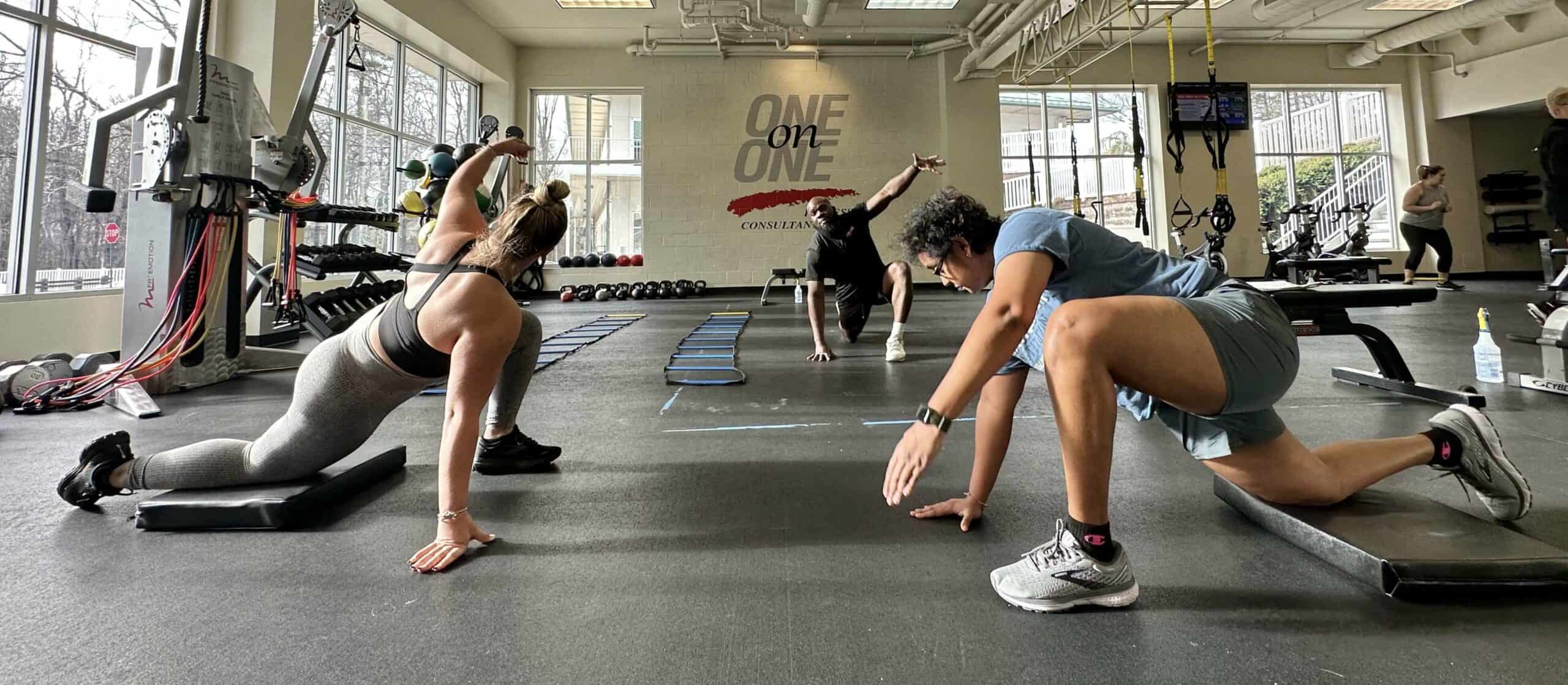
Move Better, Feel Better, Live Better with One on One Stretch
Remember when bending, walking, training, and traveling felt natural and effortless?
At One on One, we believe that ease of movement does not have to stay in the past. Our Stretch program restores mobility and reduces restriction so you can move freely and get back to enjoying the life you love.
Step confidently into the years ahead, free to travel, train, explore, and stay active!
The Story of One on One Stretch
For years, we have helped our clients maintain and improve their fitness as they age. They were strong, active, and committed to their health, yet many continued to experience low-grade pain, lingering stiffness, and restricted movement. While tools such as self-myofascial release and stretching offered temporary relief, the discomfort often returned.
We began to see a clear pattern. Discomfort led to reduced movement. Reduced movement led to deconditioning. Deconditioning ultimately contributed to more pain.
Rather than accepting this cycle as an inevitable part of aging, we chose to better understand what was happening beneath the surface. We pursued Licensed Massage Therapist credentials and advanced training in myofascial release techniques to address the root cause of tissue restriction and movement dysfunction.
From that commitment, One on One Stretch was born.
Stretch was developed as a complementary service to our fitness programs. It provides a therapeutic, guided approach to restoring functional movement patterns so that strength, balance, and mobility are not limited by chronic stiffness or recurring discomfort. Many of our clients have broken through barriers they once believed were simply part of getting older and are now moving with greater confidence, control, and freedom.

What our Stretch Clients say
I give all the credit to the Stretch program at One on One for healing my frozen shoulder and getting my full range of motion back. I had tried traditional treatments and some non-traditional ones and nothing did as much for me as did Stretch!
I couldn’t stand or walk for more than 5–10 minutes without discomfort…Now I’m able to walk longer distances, play pickleball, and keep up with my grandkids and my feet feel great! The program has also helped improve my shoulder mobility and supported my recovery from knee surgery.
I tried everything, from foam rolling to deep tissue massage, but the knots and overall tightness always came back…The approach of this program finally made sense to me. Understanding how muscle tightness and fascia lock up helped explain what I was feeling, and the Stretch program addressed the issue from the inside out.
The Science Behind Assisted Myofascial Release
Your muscles are not separate pieces that simply contract and relax on their own. They are supported and connected by a system of connective tissue called fascia. Fascia wraps around each muscle fiber, groups fibers together, and surrounds the entire muscle. It continues throughout the body, blending into tendons and supporting joints, allowing the body to function as one integrated system.
When this system is healthy, muscle fibers and connective tissue layers glide smoothly against one another. This smooth glide allows you to move freely, maintain full range of motion, and generate strength efficiently.
Over time, repetitive movement, prolonged sitting, injury, and stress can influence how this system behaves. Muscles may become chronically tight or overactive, and the surrounding connective tissue can become less adaptable. When the normal sliding between tissue layers is reduced, movement begins to feel stiff and restricted. Compensation patterns develop, and discomfort often follows.
Assisted Myofascial Release addresses these changes through gentle shearing and oscillating pressure applied directly to the muscle and surrounding connective tissue. This precise mechanical input supports healthy fluid movement within the fascia and improves how the layers glide against one another.
As glide improves, excessive muscle tension decreases and the body begins to move with less resistance. Joints feel less restricted, and muscles can respond more appropriately to the demands placed on them. Rather than forcing muscles to stretch, we restore their ability to lengthen, contract and stabilize efficiently.
When this work is combined with corrective exercise and progressive strength training, movement patterns improve in a meaningful and lasting way. The result is increased strength, improved mobility, better balance, and greater resilience over time.