

By The One on One Team
Last Updated: 1/11/2026
Simple Guidelines for Safer, More Effective Training
Proper exercise form can be broken down into a small number of repeatable concepts that apply across all movements. By consistently focusing on how you set up, how you move, and how well you maintain alignment under load and fatigue, you can dramatically improve both safety and effectiveness. In this Focus Point, we will provide three key concepts that can serve as a checklist to ensure you are set up for success with every exercise.
Key #1: Setup and Endpoints
Setup refers to how you position your body prior to beginning an exercise. It is often, but not always, identical to the initial endpoint of an exercise. Safety and effectiveness require starting every exercise in proper alignment.
Endpoints define the safe and effective range of motion for a specific movement. They are the transition points where force is decelerated in one direction and then accelerated in the opposite direction.
An individual’s initial setup and exercise endpoints are determined by several factors:
- Joint mobility
- Joint stability
- An individual’s ability to control the range of motion (motor control)
Each of these factors are slightly different for each individual and will change over time as movement capabilities improve (i.e squat depth). Most importantly, these endpoints must be respected. The potential benefits of increasing range of motion may not justify the associated risks, such as injury.
Key #2: Maintain “I”
Maintain “I” is one of our most effective postural cues. Once understood, this cue reinforces proper trunk alignment and helps ensure you move safely and effectively during both resistance training and endurance exercise.
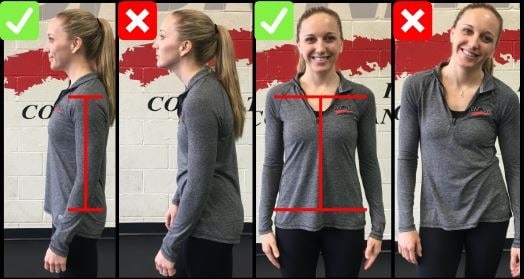
Imagine a capital letter “I” painted on your torso. The top portion of the letter is represented by a horizontal line running from shoulder to shoulder. The bottom portion is represented by a horizontal line running from hip to hip. A straight vertical line connects the two and runs down your spine.
Your letter “I” should be straight—your shoulders, hips, and spine level to the floor with the horizontal lines stacked on top of each other. Your letter “I” should also be tall, creating as much length through the spine as possible.
Key #3: Limiting “Leaks”
When a car begins to leak oil, performance gradually declines and problems develop over time. The same concept applies to movement during exercise.
Leaks occur when proper form begins to break down as a result of discomfort, fatigue, or increased intensity. When the ideal mechanics you use at the beginning of a set start to change, the exercise becomes less effective and potentially unsafe. These breakdowns often appear subtle, but they accumulate over time and can reinforce dysfunctional movement patterns.
Simply put, leaks are biomechanically incorrect compensations. Instead of moving with proper mechanics throughout the entire set, the body alters its movement strategy to make the exercise feel easier. While these compensations may allow you to complete more repetitions or handle more load, ease is not the objective. The objective is most often increased strength, hypertrophy or endurance, not just getting to a predetermined rep-range.
Conclusion
Safe and effective training doesn’t require memorizing endless cues or exercises. By keeping Setup and Endpoints, Maintain “I”, and Limiting Leaks in mind, you give yourself clear guidelines for how to move, regardless of the exercise you are performing. This week, start applying this checklist to each exercise and experience how much more effective your training can be.