
By The One on One Team
Last Updated: 4/26/26
ViPR Training Series: Mastering Non-Traditional Movement (Part 1)
In this article, we will breakdown three of our common non-traditional exercises.
Remember, the primary focus when performing non-traditional exercises is using your full range of motion. The obvious benefit is increased mobility, but when we take these movements to our end range, there are many secondary benefits, like core activation, glute activation, balance and coordination.
Pushing the boundaries of range of motion is essential in developing a resilient body. However, for active aging adults, it needs to be approached with the utmost respect and care. Muscles and Joints are most vulnerable at their end range and it can be very easy to strain a muscle if we rush or “flop” into it.
Here are some tips to safely train at your end range:
- Begin bodyweight – Use your first set of an exercise to establish safe endpoints without any external load.
- Move slowly – approach your endpoints with a controlled, slow tempo. Your body will provide feedback as you move. When you move slowly, you are able to stay in tune with what you’re feeling and stop before strain.
- Pause at the endpoint – For many non-traditional exercises, the greatest physical adaptations occur at the end range. Pausing at the endpoint both reinforces your range of motion and allows you to get the most benefit from the rep.
Vipr Reach for the Sky
Primary objective: Lengthen front of hip and shoulder
Secondary objective: Balance, hip and core activation
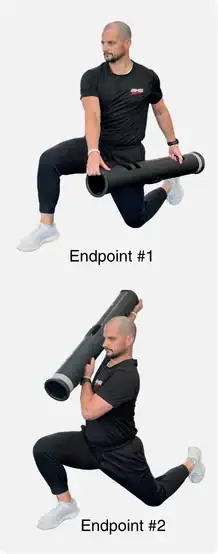
Endpoint One (EP1): Half-kneeling position with the Vipr held horizontally next to the down leg
Endpoint Two (EP2): Half-kneeling position with the Vipr reached over the opposite shoulder and weight shifted forward.
Maximize the movement: Move slowly as you transition from EP1 to EP2. Pause at EP2 to emphasize the stretch.
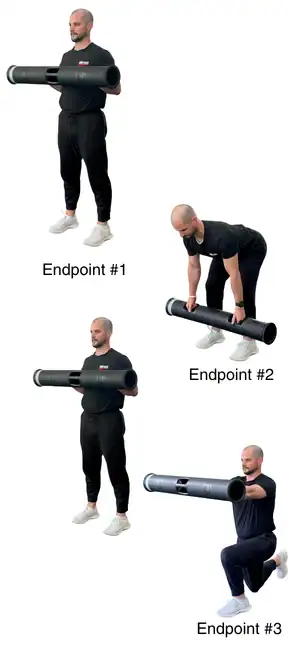
Vipr Anterior Shift
Primary objective: Core activation within a functional movement, lower body mobility
Secondary objective: Balance and coordination
Endpoint One (EP1): Tall plank stance with the Vipr held horizontally at chest level
Endpoint Two (EP2): Hinged at hips with the Vipr reaching horizontally towards the floor. Return to EP1 before progressing to EP3.
Endpoint Three (EP3): Split stance with the Vipr pressing horizontally away from chest
Maximize the movement: Initiate the movement by pushing the hips back as you transition from EP1 to EP2. Achieve a full hinge before standing tall and progressing to EP3. Emphasize the press in EP3 by “dragging out the endpoint” and challenge your full range of motion by progressing into a full lunge.
Vipr Thread The Needle (TTN) Squat
Primary objective: Core activation within a functional movement
Secondary objective: hip mobility, coordination
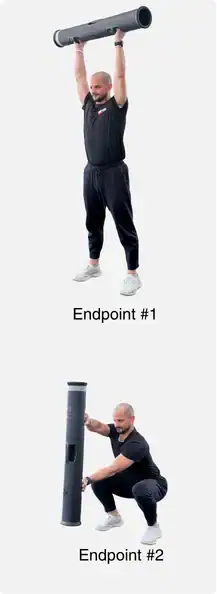
Endpoint One (EP1): Tall plank stance with the Vipr held horizontally overhead.
Endpoint Two (EP2): Squat stance with the Vipr held vertically just below chest height. Flip the Vipr as you return to EP1 and repeat.
Maximize the movement: Reach the Vipr away from your body as you complete the range of motion. Maintain Capital I posture throughout the exercise. Use your core to “put the brakes on” in EP2, stopping the Vipr from drifting towards the floor.